
How Much Protein Do You Actually Need? A Straight Answer
Every week someone asks me the same thing. “Coach, how much protein do I need?” And every week they have already been given five different answers by five different people on the internet. One gram per pound of bodyweight. Two grams per kilo. A shaker after every session. Or the opposite, that they are already eating far too much and it will wreck their kidneys.
So let me give you a straight answer, with the actual research behind it, and let me be honest about where the research stops.
First, the 0.8 g/kg number you have probably heard
The most quoted protein figure in the world is 0.8 grams per kilogram of bodyweight per day. That comes from the Dietary Reference Intakes published by the Institute of Medicine, which set the Recommended Dietary Allowance at 0.8 g/kg/day, which works out to about 56 g a day for men and 46 g a day for women at reference bodyweights. The same document sets an acceptable range for protein of 10 to 35 percent of your total energy intake.
Here is the part almost nobody explains. The RDA is a floor, not a target. It was built to be the amount that keeps almost everyone in the population out of deficiency. It was never designed to answer the question “what amount of protein helps a 41 year old dad who works ten hour days get stronger and hold onto muscle while losing fat.” Those are two completely different questions, and treating a deficiency threshold as an optimum is how a lot of people end up under-eating protein for years without realising it.
Where the 1.6 g/kg figure comes from, and what it does not mean
If you have spent any time in fitness content you will have seen 1.6 g/kg quoted as the magic number. It has a real source. A meta-analysis of 49 randomised trials covering 1,863 participants, published by Morton and colleagues in the British Journal of Sports Medicine in 2018, pooled studies where people did at least six weeks of resistance training and either did or did not take extra protein. The extra protein added about 2.49 kg to one-rep-max strength and about 0.30 kg of fat-free mass on average. And the finding everyone quotes: protein supplementation beyond a total intake of roughly 1.6 g/kg/day produced no further training-induced gains in fat-free mass.
Read that scope carefully, because it gets mangled constantly. That number describes the point where extra protein stops adding extra fat-free mass in people who are resistance training. It is not a universal daily requirement. It is not a health target. It is not established for someone who does no resistance training at all. The same analysis also found the effect got smaller with age.
So 1.6 g/kg is a useful ceiling to know about if you are lifting and trying to build. It is not a rule that everyone in Singapore is failing.
The practical ranges I actually work from
Two sources give ranges that are genuinely useful for ordinary people.
The International Society of Sports Nutrition, in its 2017 position stand on protein and exercise, concluded that 1.4 to 2.0 g/kg/day is sufficient for most people who exercise. It also notes that higher intakes, in the region of 2.3 to 3.1 g/kg/day, may be needed to hold onto lean mass in already resistance-trained people during a hard diet. That upper band is contest-prep territory for lean athletes and it is not where I put a beginner or a busy parent.
Leidy and colleagues, reviewing higher-protein diets in the American Journal of Clinical Nutrition in 2015, found benefits appearing at 1.2 to 1.6 g/kg/day. Their honest conclusion is the line I repeat most often to clients: “Dietary compliance appears to be the primary contributor to the discrepant findings.” In other words, the studies that disagree with each other mostly disagree because people did not actually eat what they were told to eat.
Be realistic about the size of the win, too. A meta-analysis of 24 calorie-matched trials in 1,063 adults found that a higher-protein diet, compared with a standard one over about 12 weeks, produced 0.79 kg more weight loss, 0.87 kg more fat loss, and spared 0.43 kg more fat-free mass. The authors themselves called those effects modest. Protein helps. Protein is not magic.
How much at each meal
Total intake matters most, but spreading it out is easier and probably smarter than dumping it all into dinner. The ISSN position stand suggests roughly 0.25 g/kg per serving, or about 20 to 40 g, every three to four hours. Leidy’s review lands in a similar place at around 25 to 30 g per meal.
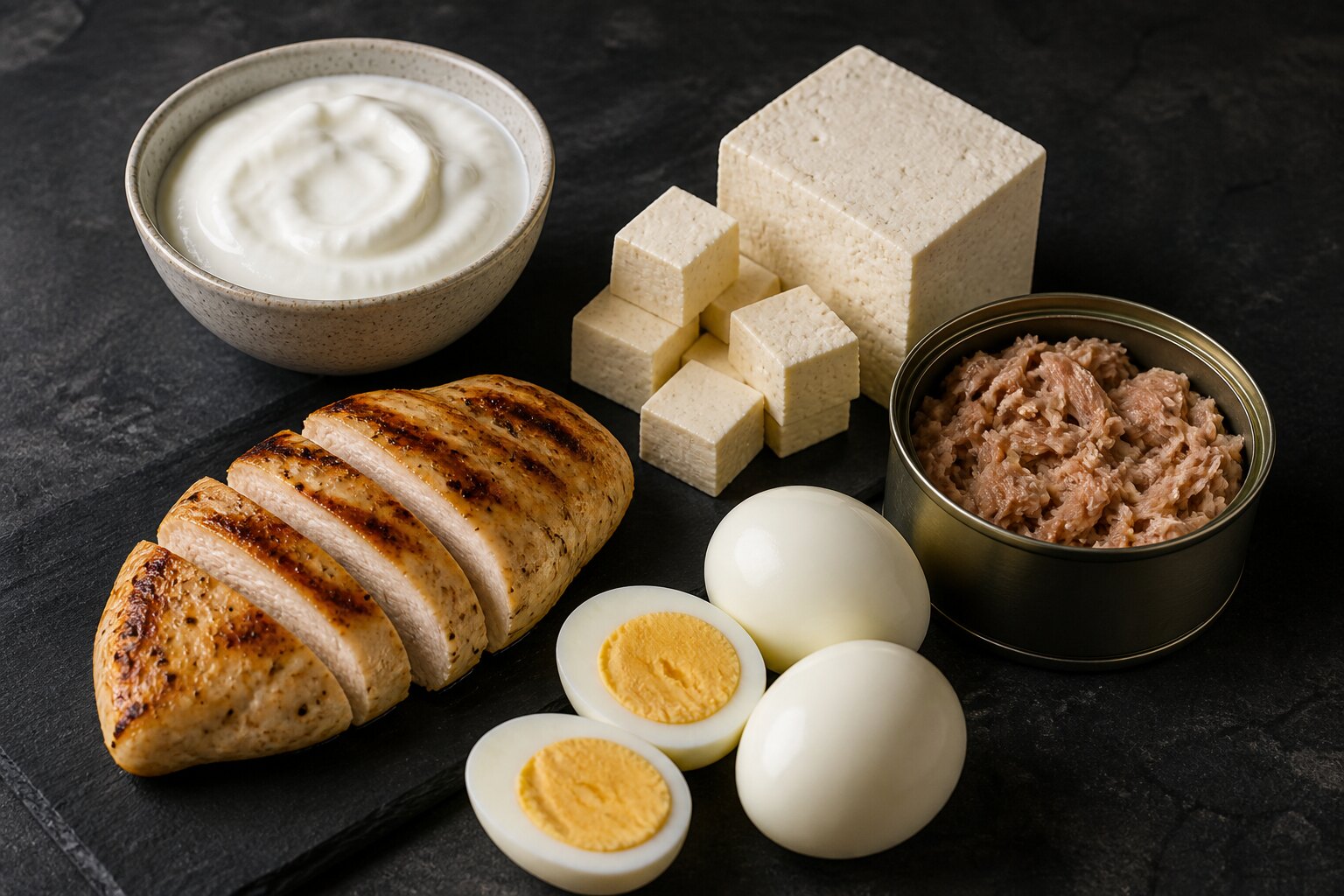
In hawker centre language, that usually means one clear protein anchor at every meal instead of one big one at night. A palm-sized portion of fish, chicken, egg, tofu or lean meat with each of your three meals gets most people most of the way there without a single scoop of powder.
The Singapore numbers
Our own health authorities publish guidance too, and it is more conservative than fitness internet. The Health Promotion Board’s HealthHub page on protein recommends about 0.8 g/kg a day for adults aged 18 to 49, which it puts at roughly 50 to 60 g a day, and steps that up to 1.2 g/kg for adults aged 50 and above.
And we are not, as a country, in a protein crisis. When MOH and HPB released the findings of the national health and nutrition surveys in September 2023, they reported more than three in four Singapore residents meeting their recommended protein intake. The gap they flagged was at the other end of the age range: one in two older adults did not meet the recommended protein intake.
If you are over 50, this section is the important one
The PROT-AGE expert group, writing in JAMDA in 2013, recommends 1.0 to 1.2 g/kg/day for people over 65, at least 1.2 g/kg for those who are active, and 1.2 to 1.5 g/kg for those living with acute or chronic illness. That lines up with HPB stepping its own figure up at 50.
There is supporting evidence for pairing that with training. A review of 20 randomised trials in adults aged 50 and over found that those on a higher-protein intake, at or above 1.0 g/kg/day, retained more lean mass and lost more fat than those on less.
The carve-out you must not skip
PROT-AGE is explicit about one exception. People with severe kidney disease, specifically an eGFR below 30 who are not on dialysis, may need to limit protein rather than increase it. That is the opposite of everything above.
So, plainly: if you have kidney disease, diabetes, are pregnant, or have any history of disordered eating, do not take your protein target from a blog post, including this one. Talk to your doctor or a registered dietitian first and let them set the number. Nothing here is medical advice, and if you are unsure where you stand, see your doctor before changing your diet.
So what is the straight answer
For a healthy adult who is training with weights and wants to keep muscle while losing fat, somewhere between 1.2 and 1.6 g/kg of bodyweight a day, split fairly evenly across your meals at roughly 25 to 30 g each, sits inside every credible set of guidelines I have quoted here. Going higher than about 1.6 g/kg has not been shown to add more fat-free mass from training. Going much lower than the 0.8 g/kg floor is not a plan.
And the single biggest determinant of whether it works is not the decimal place. It is whether you can actually eat that way on a Wednesday night after a twelve hour shift. That is the part I coach.
Sources
- Institute of Medicine (National Academies), 2002. Dietary Reference Intakes for Energy, Carbohydrate, Fiber, Fat, Fatty Acids, Cholesterol, Protein, and Amino Acids. https://www.ncbi.nlm.nih.gov/books/NBK208874/
- Morton RW et al., 2018. A systematic review, meta-analysis and meta-regression of the effect of protein supplementation on resistance training-induced gains in muscle mass and strength in healthy adults. British Journal of Sports Medicine 52(6):376-384. https://doi.org/10.1136/bjsports-2017-097608
- Jäger R et al., 2017. International Society of Sports Nutrition Position Stand: protein and exercise. Journal of the ISSN. https://doi.org/10.1186/s12970-017-0177-8
- Leidy HJ et al., 2015. The role of protein in weight loss and maintenance. American Journal of Clinical Nutrition 101(6). https://doi.org/10.3945/ajcn.114.084038
- Wycherley TP et al., 2012. Effects of energy-restricted high-protein, low-fat compared with standard-protein, low-fat diets. American Journal of Clinical Nutrition. https://doi.org/10.3945/ajcn.112.044321
- Health Promotion Board (HealthHub), Singapore. Why protein is important. https://www.healthhub.sg/well-being-and-lifestyle/food-diet-and-nutrition/why_protein_is_important
- Ministry of Health Singapore, 2023. National health surveys highlight need to focus on healthy diets and lifestyles. https://www.moh.gov.sg/newsroom/national-health-surveys-highlight-need-to-focus-on-healthy-diets-and-lifestyles/
- Bauer J et al., 2013. Evidence-based recommendations for optimal dietary protein intake in older people: a position paper from the PROT-AGE Study Group. JAMDA. https://doi.org/10.1016/j.jamda.2013.05.021
- Kim JE et al., 2016. Effects of dietary protein intake on body composition changes after weight loss in older adults. Nutrition Reviews. https://doi.org/10.1093/nutrit/nuv065
Not sure where you actually stand?
Answer seven questions and get your own daily calorie and protein target, plus a realistic date for your goal weight. Free, and no payment details.